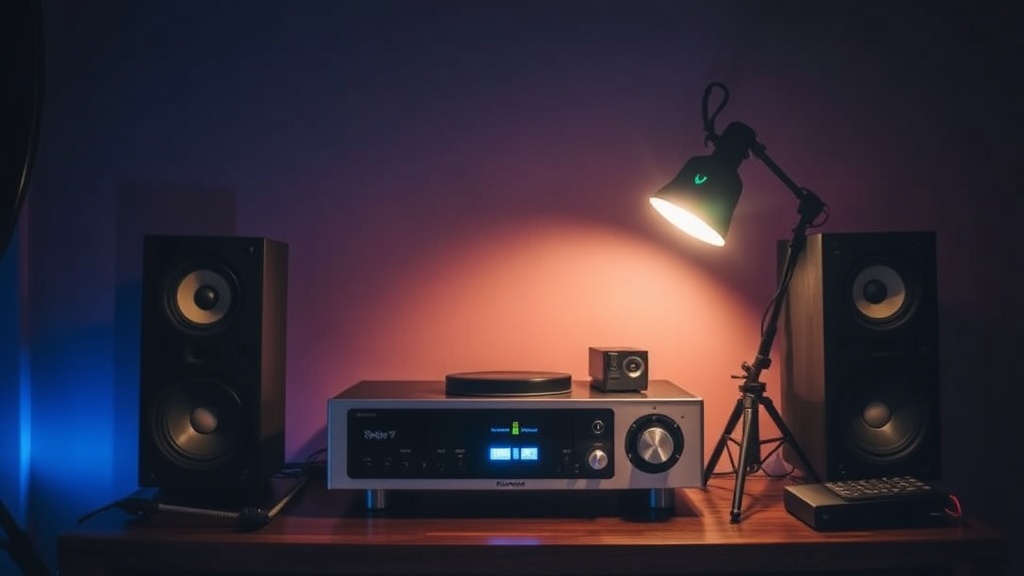
Setting Up Your First High-Fidelity Listening Station

Have you ever wondered why a certain record sounds incredibly rich in one room but thin and scratchy in another? Setting up a dedicated listening station isn't just about plugging in a turntable; it's about creating a controlled environment where your music can actually breathe. This guide covers the foundational components of a high-fidelity audio setup, the physical placement of your gear, and the small adjustments that prevent hardware damage. Getting these details right ensures your investment lasts decades rather than years.
A common mistake beginners make is treating an audio setup like a standard computer peripheral. A turntable is a sensitive mechanical instrument. It interacts with the surface it sits on, the vibration of the floor, and the acoustic properties of the walls. If you place your turntable directly on top of a speaker, the vibrations from the bass will bounce back into the stylus, creating a feedback loop that destroys your music's clarity (and potentially your stylus).
What Equipment Do I Need for a High-Fidelity Setup?
You don't need to spend thousands of dollars right away, but you do need components that work well together. A basic signal chain looks like this: Turntable → Phono Preamp → Amplifier/Receiver → Speakers. Each link in this chain matters. If your phono preamp is low quality, it won't matter if you're using $2,000 speakers; the signal will still sound flat and lifeless.
When choosing a turntable, look at the tonearm and the counterweight. A well-balanced arm ensures the needle stays in the groove without digging too deep or skipping. For the speakers, decide between active (powered) and passive (unpowered) systems. Active speakers have the amplifier built-in, which saves space, while passive speakers give you more control over how you upgrade your system over time. If you want to research specific technical standards for audio fidelity, the Audiophile 101 resources provide deep dives into signal paths.
- The Turntable: Your source of analog sound.
- The Phono Stage: Boosts the tiny signal from the needle to a level an amp can use.
- The Amplifier: Provides the power to move the speaker cones.
- The Speakers: The final voice of your music.
Where Should I Place My Turntable and Speakers?
The physical location of your gear is often more important than the gear itself. If you're living in a small apartment, you might be tempted to tuck everything into a corner. Resist this. Corners tend to collect "bass buildup," which makes your music sound muddy and indistinct. Instead, try to pull your speakers a few inches away from the wall. This allows the sound waves to propagate more naturally.
Regarding the turntable, it needs a stable, heavy surface. A flimsy bookshelf will vibrate every time the bass hits, causing the needle to jump. A dedicated heavy-duty audio rack or a thick wooden sideboard is a much better choice. You also want to keep your turntable away from direct sunlight and anything that generates heat, like a radiator or a gaming console. Heat can warp the vinyl, and sunlight can degrade the plastic over time. For more on maintaining a stable environment, check out the guidelines at Vinyl Community.
Is a Phono Preamp Necessary for My Setup?
Yes, it is. The signal coming out of a turntable is incredibly weak—much weaker than the signal from a CD player or a phone. Without a phono preamp to boost that signal and correct the RIAA equalization curve, your music will be nearly inaudible and sounding very thin. You can use a preamp built into your receiver, or you can buy a standalone unit for a more dedicated sound. Many collectors find that a dedicated external preamp provides much better detail in the high frequencies.
Placement of the phono preamp also matters. While it isn't as sensitive as the turntable, it should still be kept away from high-interference electronics like Wi-Fi routers or large power transformers. Keeping your signal path clean from electromagnetic interference (EMI) is a big part of achieving that "warm" analog sound everyone talks about.
How Do I Prevent Vibration from Ruining My Audio?
Vibration is the enemy of analog audio. There are two types: external and internal. External vibration comes from people walking by, slamming doors, or even the heavy bass from your own speakers. Internal vibration comes from the motor of the turntable itself. To combat this, many enthusiasts use isolation feet or a heavy platter. These small additions help dampen the micro-vibrations that can cause unwanted noise in your playback.
If you notice a low-frequency hum or a rhythmic pulsing while listening, you likely have a ground loop or a vibration issue. Ensure your turntable is properly grounded to the phono stage using the thin wire provided with your equipment. If the hum persists, you might need an isolation platform. A simple way to test this is to place a heavy book or a specialized weight near the base of your turntable (never on the platter!) to see if the vibration decreases.
Building a listening station is a continuous process of refinement. You might start with a basic setup, but as you listen more, you'll notice small things—a slight buzz, a lack of clarity in the vocals, or a certain frequency that feels too harsh. These aren't flaws in your music; they are clues about your hardware and room acoustics. Take your time, listen closely, and don't be afraid to move a speaker an inch to the left to see how the sound changes. The goal isn't just to hear the music, but to experience the intention of the artist through the physical medium of vinyl.